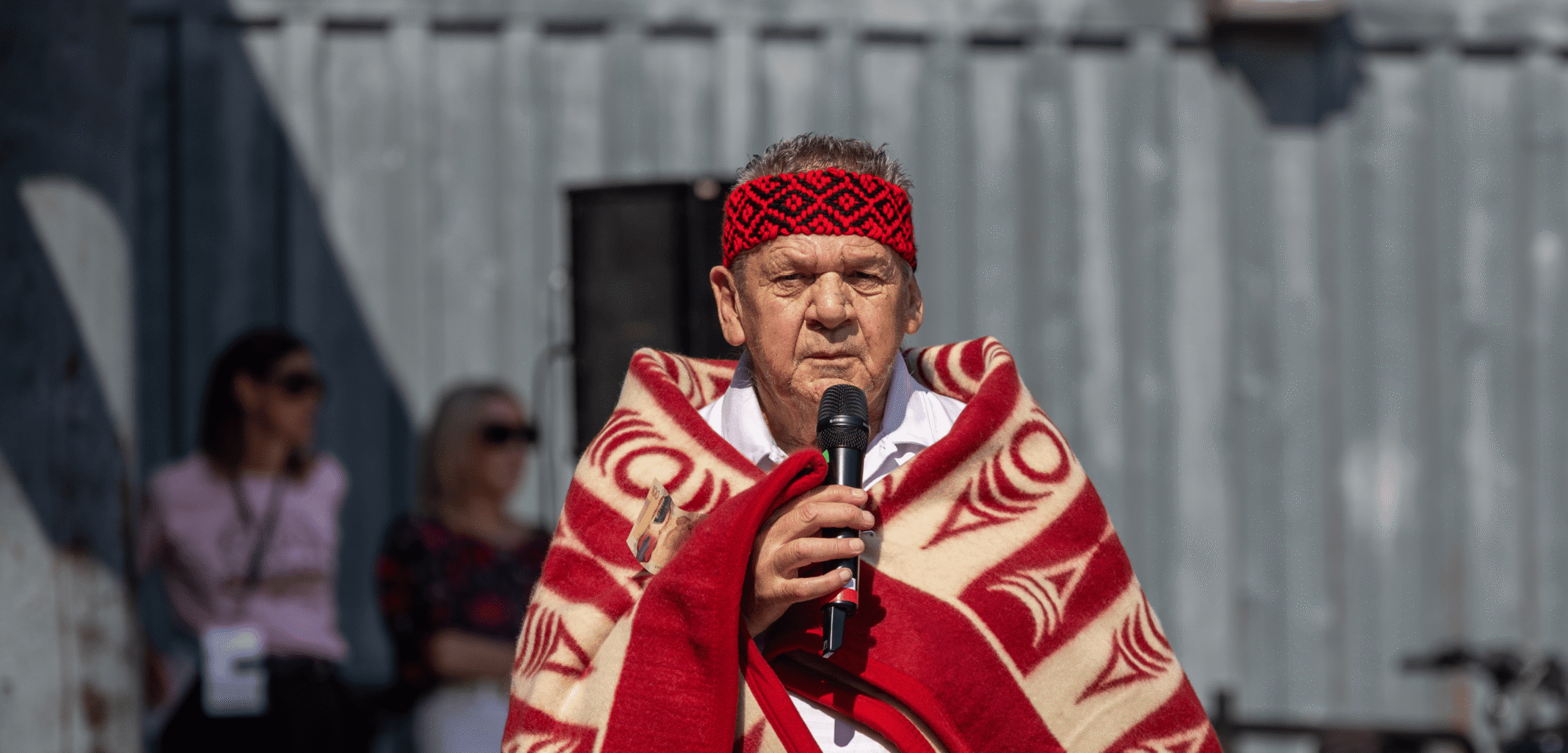
Sequiliem, Stan Joseph Jr., honoured in blanketing ceremony as Thunderbird returns to prominence
The Thunderbird emblem is beloved by the Sḵwx̱wú7mesh People. The Thunderbird icon can be seen on Squamish Nation materials, the doors, floors, and walls of its meeting spaces and workplaces. It’s tattooed on Sḵwx̱wú7mesh bodies young and old.
Recently, the Nation’s Nexwsyétsem (Communications & Engagement) team spoke with the Thunderbird’s creator, the master artist Sequiliem, Stan Joseph Jr.
Stan, born in 1950, lives on X̱wemelch’stn (Capilano Reserve), where he’s spent most of his life. A survivor of residential schools, Stan started carving at 12 years old, learning from legendary Haida artists such as Bill Reid and Kwakwaka’wakw carver Tony Hunt Sr. He also learned painting and dancing, becoming deeply skilled at Spirit dancing, specifically the dances of the Eagle and Snake. Stan’s art can be seen prominently throughout the Lower Mainland, such as the Sḵwx̱wú7mesh Úxwumixw Welcome Figure in Ambleside Park (raised in 2001 and restored in 2023) as well as the poles outside the Chief Joe Mathias Centre.
For many, however, Stan is best known as the creator of the Thunderbird emblem. Our current Nexwsxwníw̓ntm ta Úxwumixw (Chairperson & Council) recently voted to incorporate the Thunderbird element as a key part in the Nation’s branding.
Stan shared the history of the Thunderbird and its use by Squamish Nation Administration. He was asked to design a logo for the Nation back in 1973, by then Chief Khot-La-Cha, Simon Baker, who was also the band manager at the time. Simon walked into the offices of the Nation’s Ta7lnew̓ás (Education) Department where Stan was working and asked for a logo because the Nation didn’t have one yet. Stan says, “Uncle Si asked me to design a logo that would represent the People and protect the People; past, present, and future.”
Stan says he accepted the assignment and chose the Thunderbird because he grew up with the “old-timers” such as X̱ats’alanexw, August Jack Khatsahlano, Chief Joe Mathias, and Tsee-Qawl-tuhn, Chief Dominic Charlie. These Sḵwx̱wú7mesh Elders would regale young Stan with legends, and one of the main legends was about the Thunderbird.
Stan specifically remembers Chief Joe Mathias telling him that the Thunderbird was the Creator’s Messenger, sharing gifts of knowledge with the Sḵwx̱wú7mesh People, on how to survive. Stan says this oral history dates to when the Sḵwx̱wú7mesh were living in caves and the Thunderbird shared wisdom and teachings on how to use the cedar tree, and what plants and animals would heal and feed the People.
Stan’s version of the Thunderbird has three distinct tail feathers. One feather represents the past, another the present, and the third represents the future. In the bird’s claws, there is a lizard. As Stan explained, the lizard was burnt and mixed with tumuth, derived from cedar, and then ingested before dancing for incredible strength. By incorporating the lizard into the design, Stan was conveying that the Nation must remember its power.
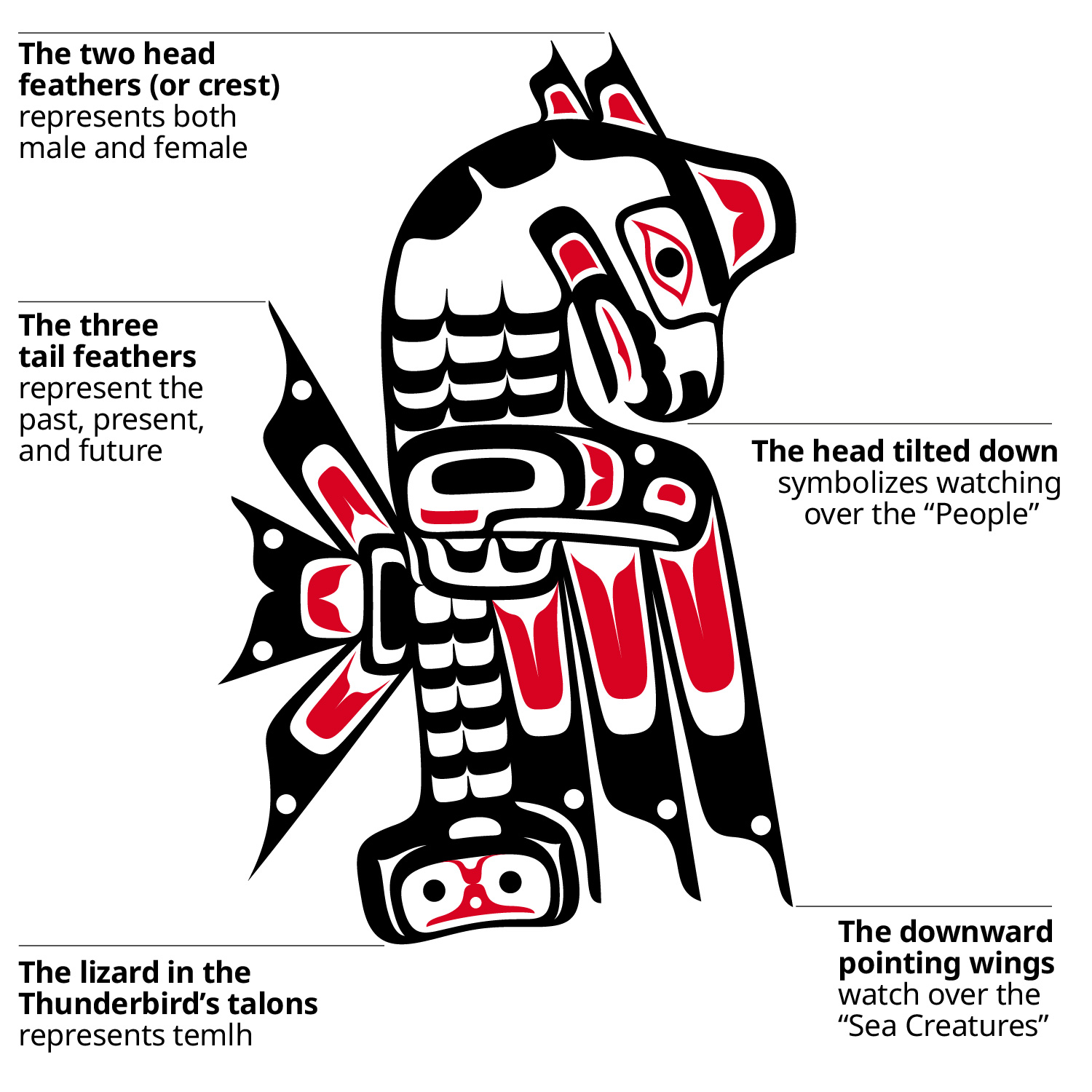
Stan shared his concerns about the Thunderbird emblem changing. Stan says, “Artists nowadays who don’t really know what the Thunderbird is want to change it. But they can’t change it, because it’s power to the People. And that’s the reason. And it was given to me by the Old Timers, the story of it. So, if they change it, it’s going to disrupt a lot of our People and a lot of our spiritual ways.”
The Thunderbird will become more prominent in Sḵwx̱wú7mesh branding and reproduced clearly, with visible detail and not resized too small. The current Sḵwx̱wú7mesh Úxwumixw logo is distinct from the Thunderbird. The logo was created in a design process in 2019 by Nicole Bonnie Retief working for the design firm hcma. The work to create the logo saw intensive input from Community and was done in conjunction with the creation of a style guide, so the Nation could communicate its identity consistently across–back then, 11departments — and various communication channels.
Stan says he wasn’t consulted for the logo design. At its smaller size he says it, “takes power away from the People.” However, he says he recognizes that the Thunderbird is difficult to see at small sizes, such as is needed in administration, as it becomes a blur.
Stan, who educated Sḵwx̱wú7mesh youth through his time working in the Ta7lnew̓ás (Education) Department, and as a mentor to the next generation of artists and dancers, has spent decades imparting wisdom and learnings to all ages of Sḵwx̱wú7mesh People.
As recognition of Stan’s many contributions to his People, his teachings, his mentoring, and his art, the Nation honoured him with a blanketing ceremony during this year’s Amalgamation Day, on July 23 at Chief Joe Mathias Centre.

Council Chairperson Sxwíxwtn, Wilson Williams, brought Stan to the stage at the 103rd edition of Amalgamation Day. In front of the crowd gathered for the special occasion, Stan was blanketed in ceremony, the Nation’s traditional gesture of respect and protection.
As the Thunderbird protects the Nation, so the Nation protected and honoured Stan with his blanketing ceremony.
Stan’s creation, skillfully drawn more than 50 years ago, will continue to represent, protect and empower Squamish People.
The power of Temlh on the Thunderbird
The colour red in Stan’s Thunderbird represents Temlh, also known as tumulth.
According to the Nation’s Archaeology Team manager, “Temlh is usually made from red clay ground down into powder, or sometimes red cedar bark.” It can be painted onto bodies or faces, or it can be ingested.
Stan remembers hearing from Elders about a version of Temlh which included the charred remains of a local lizard, which he depicted in the claws of the Thunderbird.
Stan says, “The old timers would get them (lizards) in the mountains, and they would mix it in with their Temlh, which would give them a lot of power, a lot of power. It was like they could fly when they danced.”
The choice to include the colour of Temlh was another element of protection Stan incorporated into the design of the Thunderbird. He says, “Temlh was our protection from any evil spirits or anybody that wanted to hurt us physically or mentally. So, this is why I designed it this way. Those stories that my grand uncles told me came back to me because I learned. I learned those stories from them when I was about 10 or 12-years-old and never forgot them.”