A turkey on every doorstep
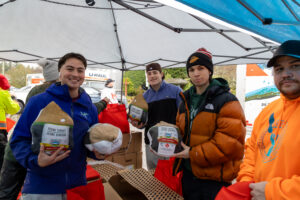
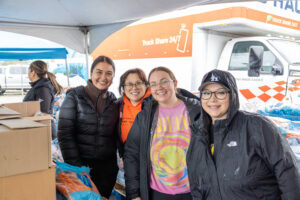
Under tents set up in a small parking lot across from St. Paul’s Indian Church, in the pouring rain, Sḵwx̱wú7mesh Úxwumixw (Squamish Nation) staff spent several damp hours packing the 2025 Holiday Turkey Dinner Hampers for our Nation’s families.
Forming an assembly line, about 40 volunteers from each of the nation’s divisions took time away from regular duties to stuff each hamper with a turkey, potatoes, carrots, stuffing, cranberries, gravy, and Christmas morning breakfast items. The packed hampers were each paired with a frozen turkey and then loaded into U-Hauls.
When a truck had 100 hampers and turkeys, volunteers drove off to begin door-to-door deliveries of the holiday package. Then the next U-Haul pulled up alongside the assembly line for loading. This five-truck rotation started in the early hours of Tuesday (Dec. 16) and went well into the afternoon. By the end, about 1,500 hampers were created and delivered to Members living on-reserve from the North Shore to the Squamish Valley.
For Members living off-reserve, hampers are picked-up, and for those living too far away to make the drive, gift cards were mailed out. For Sḵwx̱wú7mesh families living in Hiy̓ám̓ Housing, where there may not be enough space to cook an entire turkey, there was an option of a turkey roast.
The tradition of creating and delivering Holiday Turkey Dinner Hampers to each Sḵwx̱wú7mesh family was started decades ago. It has more recently become a collaboration between Ayás Mén̓men (Child & Family Services) and Ts’its’ixwnítway (Member Services).
This collaborative and enormous effort to create and deliver the hampers fulfills the mission of the Ayás Mén̓men Food Program, which is to have a “Community where hunger does not exist, and all Sḵwx̱wú7mesh citizens have access to adequate and nutritious food.”
Tanya Brown, director of Early Years and Youth Services at Ayás Mén̓men, stressed the cultural significance of the hamper tradition, saying:
“Food sharing is just part of our culture. Sharing meals, breaking bread together. It’s part of our sense of community and it’s how we bind together.”
Tallia Reginald, who has worked in Ts’its’ixwnítway (Member Services) on and off for 20 years, explained how the history of the hampers began with St. Paul’s Indian Church. Decades ago, the church identified families in need during the holidays and brought them food to ensure they’d have a Christmas dinner. Over the years, the tradition evolved to the point where Nation staff took over the preparation and distribution of the hampers and began to include every Sḵwx̱wú7mesh family, what Reginald described as “a turkey on every doorstep”. She noted the full circle moment as volunteers gathered out front of the church which started the tradition, and continued to feed the Nation, bringing it even closer through the sharing of food, and ensuring no Member will go hungry during the holidays.