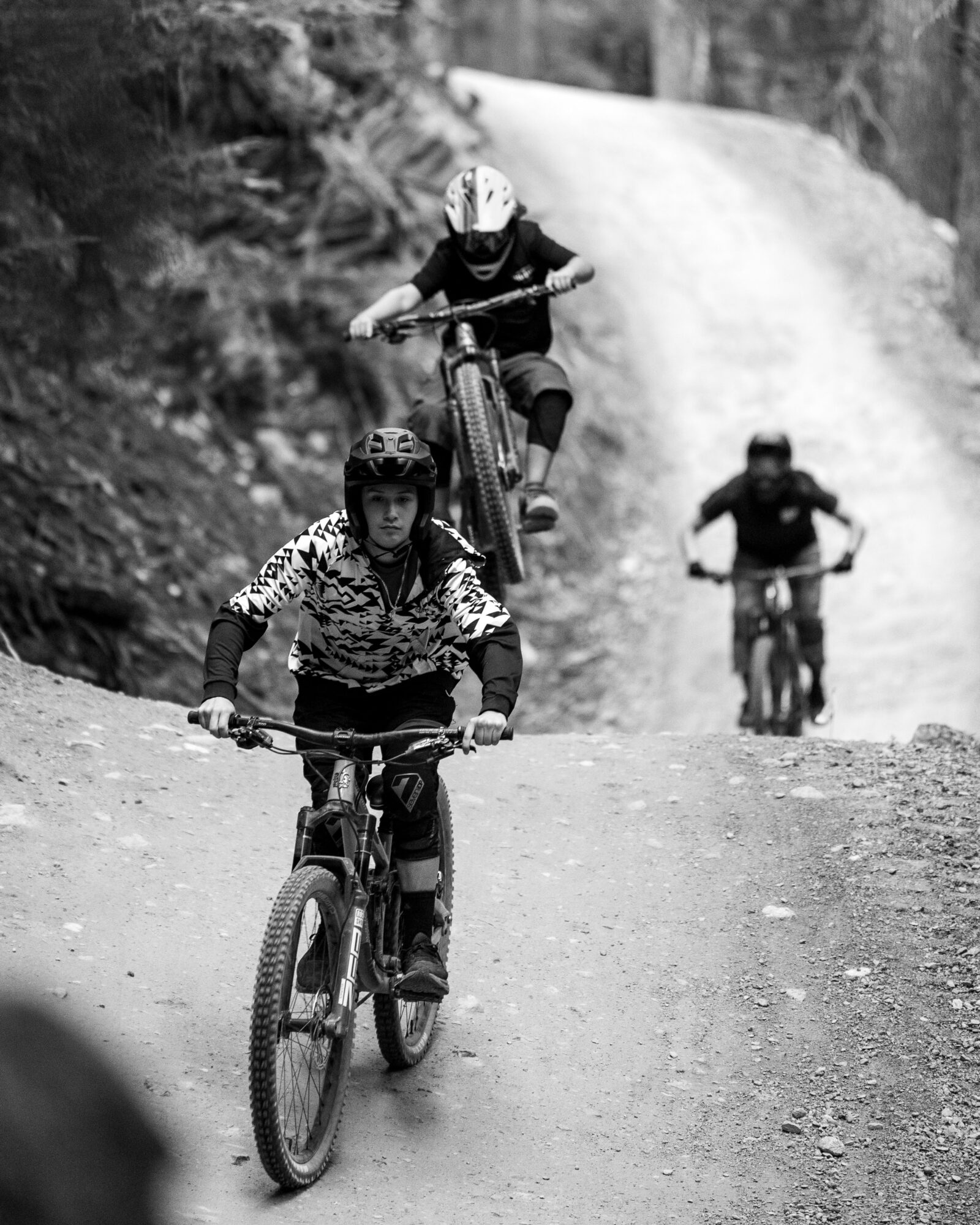
The Menmen tl’a Sḵwx̱wú7mesh (Children of Squamish) mountain bike team, founded in 2019, offers a program for Sḵwx̱wú7mesh kids to learn about safe riding, the lands of their ancestors, and the culture of their Community.
In a new tradition for the group, the young riders, (some as young as six and going up to Grade 12), embark on an annual tour of ancestral Sḵwx̱wú7mesh villages, stopping at the homes of Elders to chat, snack, and learn. This year’s Rez Ride took place in October and saw the youth end their tour with an awards ceremony and the screening of a highlight reel of some of the best tricks, or crashes, of the year.
In the warmer months, the group rides several times a week, led by coaches and teachers Matthew Van Oostdam, (who started the group), and Natasha Harvey. Since the team began, the young riders have formed deep bonds, and the older members have begun mentoring the younger ones, passing on the skills needed to speed through the many trails and tracks on Sḵwx̱wú7mesh land.
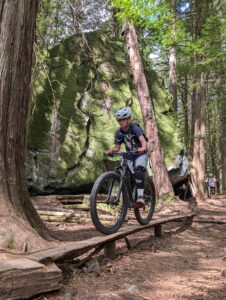
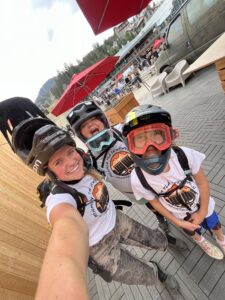
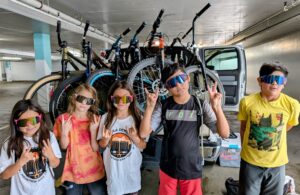
Van Oostdam, a teacher at St’a7mes School, began the Menmen tl’a Sḵwx̱wú7mesh program after noticing so few Sḵwx̱wú7mesh youth taking part in one of the world’s busiest mountain biking scenes, right on their own hereditary lands.
This realization occurred as Van Oostdam was teaching Grades 4-6, so he brought some of his students out on bikes. The team started operating from the school as he took groups of kids riding on Fridays instead of sitting in a classroom. Slowly the team grew, and one year, Van Oostdam says, the girls showed up in force, scaring some of the boys away. That version of the team was made up of seven Sḵwx̱wú7mesh girls who showed more commitment and dedication to the sport than he’d witnessed before and progressed from the fundamentals of mountain biking to riding the Whistler bike park, with its expert-level areas. Some of the girls from that team, now teens, still come on team rides to help with mentorship.
As the team grew so did the partnership with Sḵwx̱wú7mesh Úxwumixw Recreation, SORCA (Squamish Off Road Cycling Association), and Dialed in Cycling. After a signed agreement between SORCA and the Nation’s Ta na wa Yúus ta Stitúyntsam̓ (Rights and Title) department, the team’s support became more dependable and official. Sḵwx̱wú7mesh Úxwumixw Recreation contributes staffing for the project, allowing young Sḵwx̱wú7mesh Members the opportunity to learn and become coaches. SORCA provides all of the funding, logistics, and brand relationships. Right now, the team is as full as funding allows, with 17 participants and a waitlist to join. SORCA contributes about $40,000 per year on funding and equipment.
Van Oostdam says, “This team would not be possible without the support of so many community partners who help with food, snacks, bikes, clothing, and helmets. And of course we can’t forget ice cream. The team has a special sponsorship with Alice and Brohm ice cream.”
Van Oostdam emphasizes that, “An important distinction with the team and program is that it is zero barrier. With no cost to parents, the program provides transportation, equipment, backpacks, helmets, pads, modern and maintained mountain bikes, and professional coaches.”
Recently, Sḵwx̱wú7mesh Úxwumixw Recreation member Jacob Kitagawa joined up, and Nation Members Selena Newman and Pauline Baker also worked with the team as coaches-in-training for a summer. Former team member Rachel Fenton, of the Xwísten First Nation (Bridge River Indian Band, part of the St’át’imc Nation), who was raised in the Sḵwx̱wú7mesh Community, pursued coaching as she aged out, and now coaches for the team in the summers.
The team’s usual bike days, which sees kids get picked up from their homes, fed, and instructed in safe riding, are held in Sḵwx̱wú7mesh on the multiple trails. But occasionally the kids get to go on excursions to other Sḵwx̱wú7mesh territories such as Chxwelp (Gibsons), or to Whistler or North Vancouver. There are even inter-Nation camping trips, like to Simpcw First Nation north of Kamloops.
Spaḵíya, aka Lindsay Hubley, is a manager of Squamish Valley Operations Recreation and Community Facilities. She and the other Menmen tl’a Sḵwx̱wú7mesh organizers meet annually to discuss the program. Among the new additions to the team is a bike rack for the recreation minivan, enabling Kitagawa to shuttle the team out on Friday rides — until it snows or gets too cold to ride. The team’s connection to the Sḵwx̱wú7mesh Úxwumixw also allows it to benefit from the Nation’s agreement with Whistler Blackcomb, which sees the donation of lift tickets for downhill rides on the mountain.
As for the future of this team, Squamish Valley Operations hopes to increase capacity by finding funding to hire a full-time outdoor recreation facilitator. This role would see someone join the kids in mountain biking and also in other outdoor recreation programs. But as Spaḵíya explains, the draw of other sports may not be enough to lure away the kids from Menmen tl’a Sḵwx̱wú7mesh. She said, “These children are committed to their sport. Sometimes programs conflict and the mountain bike kids choose biking over summer fun or teen centre field trips.”
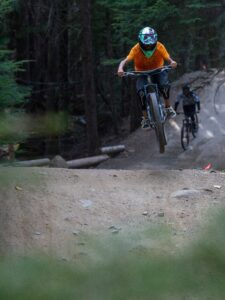
While the team’s biggest need to ensure its survival is regular funding, Van Oostdam adds that a large part of the work is relational. He says, “coaches need to take the time to build safety and trust. Mountain biking can be scary. It is a lot to ask of young kids to trust someone, to try new sports, and to challenge themselves. With proper funding we are able to hire coaches that are skilled and build those lasting relationships that not only support the youth in their mountain biking but also in becoming good humans.”
Van Oostdam says the team means something different for every child. For some, the team is a place of safety, a space to have fun, be themselves, and play with their friends. He says, “For other kids, they want the challenge. They want to test themselves physically and mentally. So much in mountain biking is in your mind and by practicing the sport we train our mind to be strong.”
Van Oostdam is looking forward to next year’s season, as it will be the first with three coaches. This will mean the “youth will get out more often and receive an even higher level of coaching.” But as things change, some things stay the same, like how each new season starts off with a formal contract signing. This has the kids commit to being in good standing in the community and to follow the team’s values of Nchumut Nch’ú7mut (being one, or being one piece of something greater) and Chén̓chenstway (to support and uphold one another).